Quick Links
Online Catalog
From Aida To Zweigart--Yarn Tree
is the source for cross
stitch. 1,000's of
products and patterns from your favorite designers.
Search
Search
Online Catalog.
Where To Buy
Support your local needlework store!
If your favorite store is not
on the list, ask if they will special order for you.
Contact Us
Your best source for needlework for over 35 years.
|
 Niche
Marketing Niche
Marketing
Return to
Marketing and Promotion page
I once saw a sign in a restaurant,
"Price, Quality, Service. Pick any 2."
There is a lot of truth to this. It is simply not possible to always
have the lowest price, the best quality product, and the best customer
service.
Niche marketing is simply finding an under served section of
the market, and positioning your business to serve that section of the
market.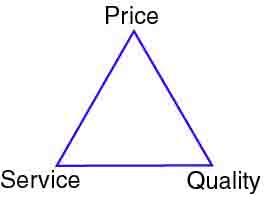
For retail stores, the 3 main variables are Product Price, Product
Quality, and Customer Service. Looking at the triangle diagram to the
right, a store can position itself anywhere inside the triangle. Moving
closer to any corner means moving away from the other 2 corners.
For example, a store can position itself as having the lowest prices,
but to stay in business it has to sacrifice customer service and product
quality.
RULE 1: Do not compete head to head, especially against a bigger
business.
Niche marketing is not about trying to be everything to everybody.
Instead, the goal is to satisfy the wants and needs of a specific group
of customers better than your competition. You never want to compete
head to head, especially with a larger business.
Start by listing your competitors. They may be discount stores, the
internet, etc. Next, mark where each competitor is on the triangle. As a
niche marketer, you should position your store in a area of the triangle
that is not being served.
RULE 2: Compete against your competitor's weaknesses.
Whenever possible, compete against your competitors weaknesses, not
their strengths.
Suppose one of your main competitors is the local DiscountMart. Their
strengths and weaknesses are pretty straightforward. Strengths: low
price, a lot of product categories, large ad budget. Weaknesses: poor
customer service, no lessons, limited selection of needlework, image is
associated with low quality.
Using niche marketing, instead of competing against the chain store's
strong points (price, size), you should compete against their weaknesses
(quality, selection, and service).
RULE 3: Do not position your store directly between 2 other
competitors.
Suppose you have 2 chain stores in your area and both are competing
on price; but one store has slightly better customer service, and the
other store slightly better selection. You would not want to position
your store directly between the two stores because as they compete
against each other, you will be caught in the cross fire.
RULE 4: Make sure the niche you choose is large enough to support
your business.
Sometimes the market you want to sell to is just too small to support
the business you want to have. If this is the case you have two options:
1) find a larger market, or 2) reduce the size of your business (that
is, reduce your monthly expenses to fit your market). A small,
profitable business is much better to own than a large, unprofitable
business.
|
 Visit Yarn Tree's
Facebook &
Instagram
for new products and news. Visit Yarn Tree's
Facebook &
Instagram
for new products and news.
|

 117
Alexander Avenue, Ames, Iowa 50010.
117
Alexander Avenue, Ames, Iowa 50010.  Ordering. All
the items shown here are available to retail stores from Yarn Tree. We encourage you
to contact your
Ordering. All
the items shown here are available to retail stores from Yarn Tree. We encourage you
to contact your